
70% of Telecom Transformations Fail. The Architecture Isn't the Problem — the Coupling Is.
Your BSS/OSS Stack Is Holding You Hostage
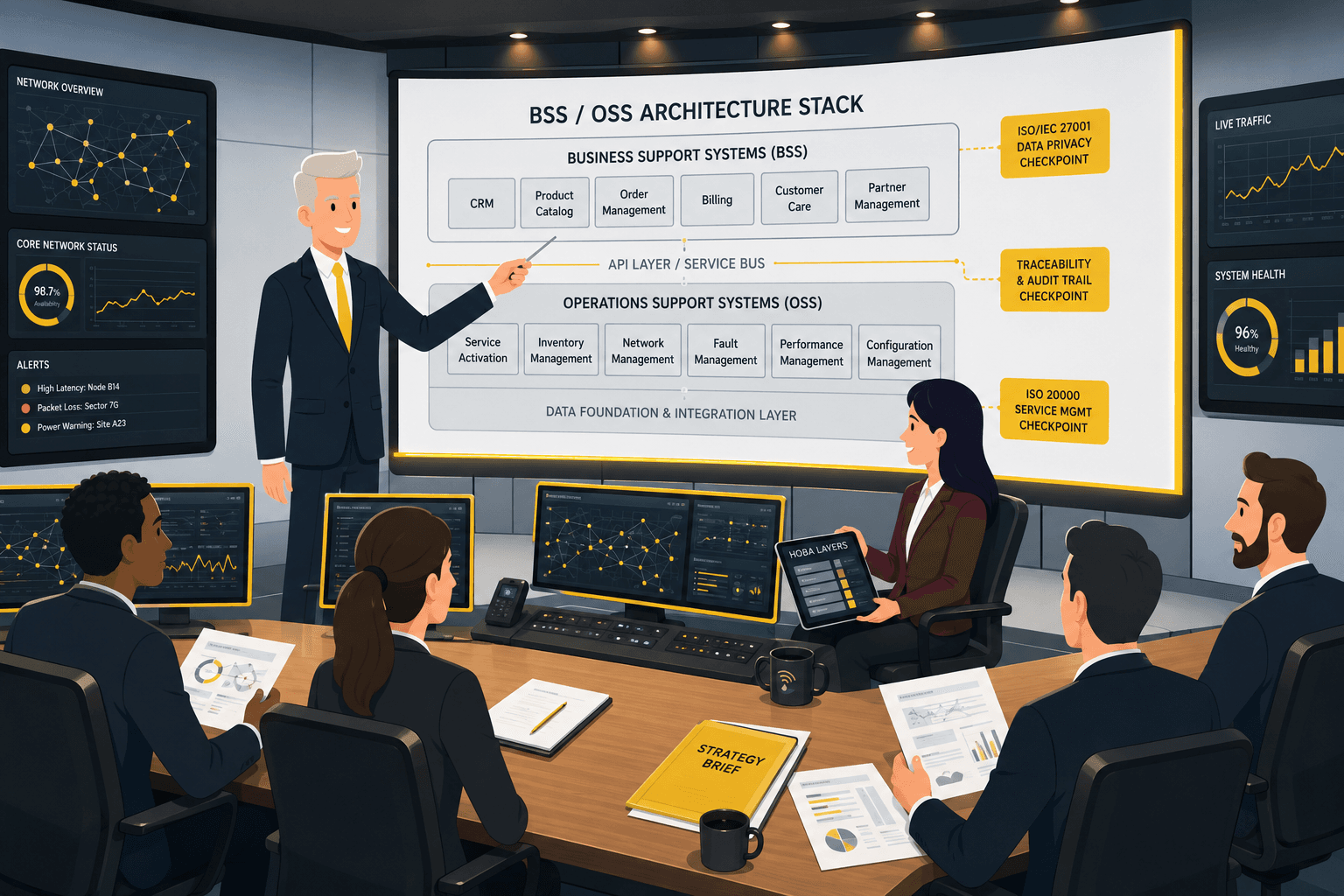
Telecom BSS/OSS environments are among the most complex technology estates on earth. Billing systems chained to CRM. Network inventory welded to service provisioning. Order management duct-taped to fulfilment engines.
The result? Process Debt that compounds faster than you can pay it down. Vendor lock-in that makes 'switching' a fantasy. Tight coupling that turns every small change into a six-month integration project. Shadow IT proliferation. Transformation fatigue. Board scepticism.
The vendors will tell you their new platform replaces everything. The integrators will tell you they can untangle it. But if architecture and implementation aren't decoupled first, you're just re-platforming the same mess into a more expensive box.
The Layers Model Meets the Stack
HOBA Pro was built on a simple, radical idea: architecture is not implementation.
Our 3 Ls map directly onto the BSS/OSS separation that telecom architects have been trying to enforce for decades. They give you a common vocabulary that works for network engineers and CFOs alike.
Architect the separation before you touch a system. Decouple so you can swap, not scrap. Build vendor-neutral architecture. Make Process Debt visible — then pay it down. Use AI-enabled analysis to accelerate what humans alone cannot.
This isn't another tool that promises to 'transform your digital estate.' It's a business-led, architecture-first methodology that recognises telecom complexity and gives you a way through it.
Built for Telecom Complexity
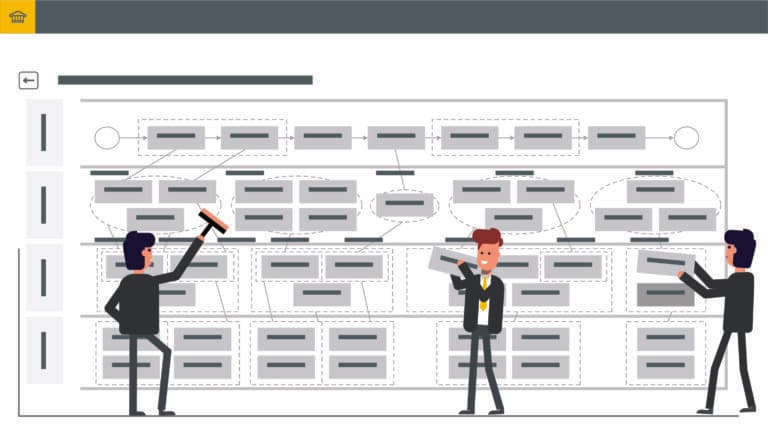
Layered Architecture Mapping for BSS/OSS
- BSS layer mapping: product catalogue, CRM, billing, revenue management — architected as capabilities, not vendor products
- OSS layer mapping: network inventory, service provisioning, fault management — separated from business process
- Coupling analysis: visualise which integrations are structural and which are debt
- Vendor overlay: map current and target vendor estates against the architecture layer
Process Debt Detection in Legacy Stacks
- Debt scoring: quantify the drag of accumulated workarounds on operational efficiency
- Root-cause traceability: link every instance of Process Debt back to an architectural gap
- Paydown sequencing: prioritise debt elimination based on transformation impact
- Prevention architecture: design new processes that don't recreate future debt
Vendor-Neutral Transformation Roadmapping
- Multi-vendor scenario modelling without locking architecture to any supplier
- Migration wave planning that keeps revenue-critical systems running
- Risk-adjusted timelines that model the real cost of integration complexity
- Governance framework to maintain architectural integrity as vendors execute
AI-Enabled Legacy System Analysis
- Automated dependency mapping from logs, APIs, and data flows
- Decoupling candidate scoring by difficulty and business value
- Transformation risk prediction: model where changes will cascade or fail
- Accelerated discovery: reduce analysis paralysis from months to weeks
Decouple. Architect. Transform.
Baseline Your Architecture Layer
For Telecom Leaders Who've Seen Programmes Fail
Telecom Transformation Leads
CTOs and CIOs
BSS/OSS Architects
Systems Integrator Managers
What Changes After HOBA Pro
Architecture becomes the constant, not the variable
Process Debt becomes visible and actionable
Vendor negotiations become capability-driven
Transformation risk becomes modelled
Your board sees architecture, not just expense
How HOBA Pro Differs for Telecom
Traditional SI-Led Transformation
Systems integrators bring their methodology and assumptions. They discover your complexity at your expense, usually around month four. Architecture is produced as a deliverable, then filed.
HOBA Pro: the architecture exists before the integrator arrives. Their value is execution against a clear blueprint — not improvisation against a vague brief.
Vendor-Native Roadmaps
Vendors design architectures that favour their platform. The result is a BSS/OSS stack that works beautifully within one ecosystem and poorly everywhere else.
HOBA Pro: architecture is vendor-neutral by design. The capability layer describes what the business needs. The implementation layer maps to whatever vendor landscape makes sense.
Tool-Only Approaches
Process mining and APM tools show you what's happening. They don't tell you what should be happening, or how to bridge the gap.
HOBA Pro: the published framework means your team shares a common language and methodology. The AI-enabled software accelerates what the framework teaches.