73% of AI Projects Fail Because Nobody Mapped the Shadow Processes | HOBA
📷Click on any image to enlarge.
73% of AI Projects Fail Because Nobody Mapped the Shadow Processes
Shadow Processes Aren't Edge Cases. They're the Real Process.
Here's the lie every organisation tells itself before buying AI tools: "We'll automate the processes we already have."
It's not happening. And the reason isn't the AI. It's the process.
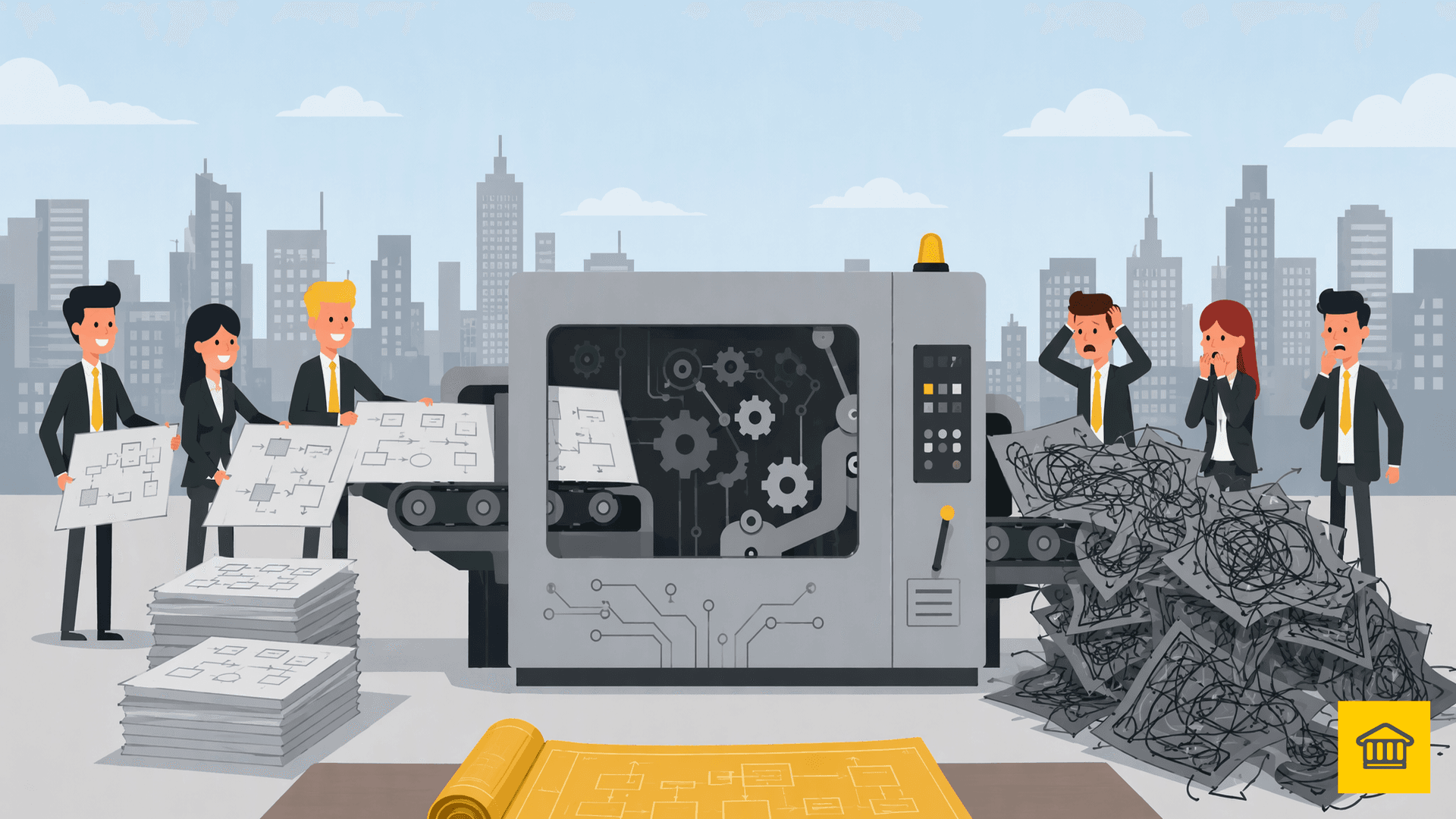
Every organisation runs two versions of itself. The official version — the one on the process maps, in the training manuals, in the compliance reports. And the real version — the workarounds, the spreadsheets, the manual checks, the emails that say "just do it this way for now." That's Shadow Processes. And they aren't exceptions. In most organisations, they are the majority of the actual work.
You cannot automate a Shadow Process. You can only automate the chaos it creates. That's not transformation. That's faster dysfunction.
The HOBA way starts with seeing before building. Map the business as it actually runs — official processes and Shadow Processes, one shared Language from boardroom to frontline, every process decomposed to the Level of detail its risk demands. That's the 3 Ls: Layers, Language, Levels. You cannot deliver a change you refuse to see.
The Lie vs. The Reality
Every stalled AI project has a post-mortem, and almost all of them blame the wrong thing. Here's the honest ledger:
| The Lie | The Reality |
|---|---|
| "Our processes are documented and ready for AI." | You have process maps. The real work happens in email chains and spreadsheets nobody modelled. |
| "AI will find the patterns we missed." | AI trained on incomplete process data finds patterns in noise. It automates the wrong work faster. |
| "Shadow Processes are just exceptions." | Shadow Processes are the norm in most organisations. The exceptions are the documented ones. |
| "We'll fix the process after the AI is live." | Post-go-live process fixes are called post-mortems. And they cost more than the AI licence. |
| "Our vendor said the tool works out of the box." | Every tool works out of the box — on the process it was designed for. Yours isn't that process. |
None of this is an argument against AI-enabled change. AI is a powerful capability. But it is a final step, not a first one. And the step that comes before it — mapping, eliminating, standardising, and governing the real process — is where most programmes skip straight to the finish line.
 🔍 Click to enlarge
🕳️ “73% of AI projects fail because nobody mapped the Shadow Processes. You can't automate what you refuse to see.” #ShadowProcesses #BusinessArchitecture

Why AI Makes Shadow Processes Worse, Not Better
Most organisations approach AI-enabled transformation backwards. They buy the tool first. Then they discover the process doesn't fit. Then they build workarounds around the tool. Then they hire consultants to integrate the workarounds. Then they wonder why the ROI never arrived.
This is not a technology problem. It's an architecture problem.
Shadow Processes exist because the official process doesn't match reality. When you drop AI onto a broken process, one of two things happens:
- The AI automates the official process — and the Shadow Processes grow around it, creating bigger gaps between what's modelled and what runs.
- The AI learns from the Shadow Processes — and automates chaos at scale, embedding undocumented workarounds into production systems.
Either way, you haven't transformed anything. You've installed a jet engine in a horse cart — and now the cart is moving faster in the wrong direction.
The fix isn't more AI. It's Business Architecture. Map the real process first. Eliminate what shouldn't exist. Standardise what should. Optimise what remains. Only then apply AI — as the final rung of a structured climb, not a heroic leap into the dark.
Two weeks ago we covered the full climb — the 4+1 Ladder, and why organisations that skip the +1 implementation rung end up with beautiful designs and no delivery. The short version: the +1 is where you govern what you built. And you can't govern what you never mapped.
 🔍 Click to enlarge
🐎 “Dropping AI onto a broken process is installing a jet engine in a horse cart. Either the shadow processes grow around it, or you automate chaos at scale.” #AIEnabled #StopPatching
In Government and Financial Services, Shadow Processes Are a Control Failure
If you lead transformation in a regulated environment, Shadow Processes aren't just inefficient — they're a regulatory time bomb.
A regulator does not accept "the official process says X" when the real process does Y. The National Audit Office does not sign off a compliance report that doesn't match the operational reality. When the FCA asks who authorised a decision, how it was traced to an outcome, and what process was actually followed, a Shadow Process is not an answer — it's a finding.
In regulated industries, the gap between documented process and real process is called a control failure. And control failures scale. One undocumented workaround becomes ten. Ten become the standard operating procedure. And when the audit arrives, the organisation discovers it has been running a parallel business that nobody modelled, nobody governed, and nobody can explain.
This is why Business Architecture matters more in Government and Financial Services than anywhere else. Not because the processes are more complex — because the consequences of invisible processes are more severe.
Last month we covered why Process Debt is the real killer in regulated transformation — and why treating implementation as an afterthought creates findings, not outcomes. The short version: when your real process lives in the shadows, your compliance lives on borrowed time.
The Process Most Organisations Actually Run
| The Usual Programme (Design-First) | The HOBA Way (Architecture-First) | |
|---|---|---|
| What gets mapped | The official process. The one in the training manual. | The real process. Official and Shadow Processes, decomposed to the right Level. |
| What gets automated | Whatever the AI vendor's tool handles out of the box. | Only what survives Eliminate, Standardise, and Optimise. |
| Who owns the process after go-live | Nobody — the consultants left, and the Shadow Processes took over. | Named business owners, with governance loops and a shared Language. |
| Proof of value | "The AI tool is processing transactions faster." | Every automated step is traced to a decision, an owner, and a business outcome. |
| 18 months later | The Shadow Processes have grown. The compliance gaps have widened. | The architecture evolves. The change compounds. |
| Outcome | Faster dysfunction, with an audit trail nobody can explain. | A transformation the business actually owns and the regulator can verify. |
Read the ownership row again. That's the entire argument. The technology was never the problem. The architecture was.
What Fixing Shadow Processes Actually Looks Like
Fixing Shadow Processes isn't a technology project. It's a Business Architecture discipline. Here's what it means in practice:
Map before you model. Use the 3 Ls — Layers, Language, Levels — to build a single, governed view of how the business actually runs. Not how it should run. How it runs. That means interviewing the people who do the work, not just the people who designed the process map. It means documenting the workarounds, the spreadsheets, the manual checks, and the "just do it this way for now" habits that have become standard operating procedure.
Eliminate before you automate. Most Shadow Processes exist because the official process is broken, outdated, or ignored. The 4+1 Process — Eliminate, Standardise, Optimise, Automate, then apply AI — is the applied version of everything in this post. Deleting a broken process is the cheapest transformation you'll ever fund. Automating it is the most expensive mistake you'll ever make.
Govern before you go live. Every process — official and Shadow — needs an owner, a level of decomposition matched to its risk, and a traceability loop that survives the first time something goes wrong. Not a document. A structure. An architecture repository that outlives the programme and evolves with the business.
Then — and only then — apply AI. AI-enabled change as the final step of a structured strategy, not a substitute for having one. When you can see the full process, you can automate the right work. When you can't, you're just making faster mistakes.
You don't need a faster horse. You need to see the road you're actually on.
 🔍 Click to enlarge
🔦 “Fixing Shadow Processes isn't a tech project. It's Business Architecture. Map before you model. Eliminate before you automate. Govern before you go live. Then apply AI.” #BusinessArchitecture #4Plus1Ladder
What You Actually Get
Let's answer the only question that matters: what does the customer get?
Not another AI tool. Not another process map that gets archived. Not a target operating model that describes a business nobody actually runs.
You get a Business Architecture your organisation owns: a single, governed model of what your business actually is — official processes and Shadow Processes, mapped, owned, and decomposed to the Level of detail your risk demands. You get named owners, traceable decisions, and an architecture repository that outlives the programme. You get the 3 Ls — Layers, Language, Levels — as a shared language from boardroom to frontline. And you get an AI-enabled transformation that starts with seeing and ends with delivery — instead of starting with ambition and ending with a faster mess.
The 73% failure rate isn't a law of nature. It's a visibility problem. Shine a light on the Shadow Processes — map them, own them, govern them — and you're in the minority that ships.
Stop Patching. Start Architecting.
If your last AI project produced faster transactions and bigger compliance gaps, you don't have a tool problem. You have a visibility problem — and the fix isn't more AI. It's architecture.
Take the HOBA AI assessment and find out — in plain terms — whether your organisation is automating what it can see, or accelerating what it can't.
Stop Patching. Start Architecting.

Heath Gascoigne
Hi, I'm Heath, the founder of HOBA TECH and host of The Business Transformation Podcast. I help Business Transformation Consultants, Business Designers and Business Architects transform their and their clients' business and join the 30% club that succeed.
TRANSFORM YOUR
ORGANIZATION
WITH THIS SIMPLE PROCESS
WE OFFER THE TRAINING FOR PEOPLE TO GO AND LEARN THE SKILLS NEEDED TO ACHIEVE THE SAME RESULTS AS ACHIEVED IN THIS CASE STUDY.
ENJOYING THIS POST?
GET THE NEXT ONE
Subscribe to our newsletter and get the latest insights delivered straight to your inbox.

Make HOBA Tech a Google Preferred Source.
One click and Google will start showing our articles in AI search results and AI Overviews when you search.
🚀 “Just read: "73% of AI Projects Fail Because Nobody Mapped the Shadow Processes | HOBA" — incredible insights on business transformation.” #BusinessTransformation