6 Steps To Business Transformation
📷Click on any image to enlarge.
Welcome to this insightful blog post from HOBA Tech, where we demystify the process of business transformation by breaking it down into six manageable steps. This post is designed to guide you through each step, providing a comprehensive understanding of what each entails and how it contributes to the overall transformation process. The goal is to equip you with a clear roadmap to navigate your business transformation journey successfully. Here's a quick overview of what you can expect from this post (click the links to skip to the section below): NB: Click the images to expand them 📸
Before we discuss the 6 steps, let’s first discuss business transformation. We’ve had a lengthy discussion on business transformation in a previous post.
But in reality hearing the acronym “TOM” (Target Operating Model) instills fear in many businesses. They’ve learned through the grapevine and other means that developing, designing and implementing a TOM was difficult (well that is about to change)!
The TOM is relatively misunderstood, as is the name Business Architect, and Business Architecture. The Business know that they need the latter (to develop the former), but they don’t know what they do, or how to get started… There’s a lot missing from existing approaches, in developing an Organisations Business Architecture, and TOM.
There is not a holistic joined-up approach. There’s also (un)intentional confusion created by the the different parties involved from consultants with their agendas to the different stakeholders protecting their empires… This is why we created the 6-Steps to business transformation, which we’ll discuss in-depth below:
The 6 Steps To Business Transformation
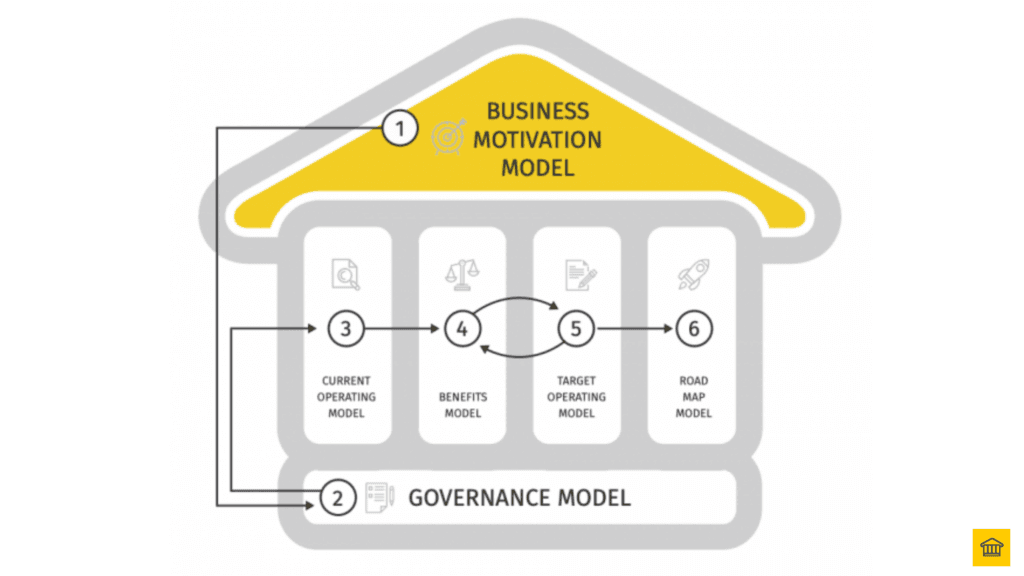
Here are the steps you need to develop and implement your TOM and transform your business:
Step 1: Focus
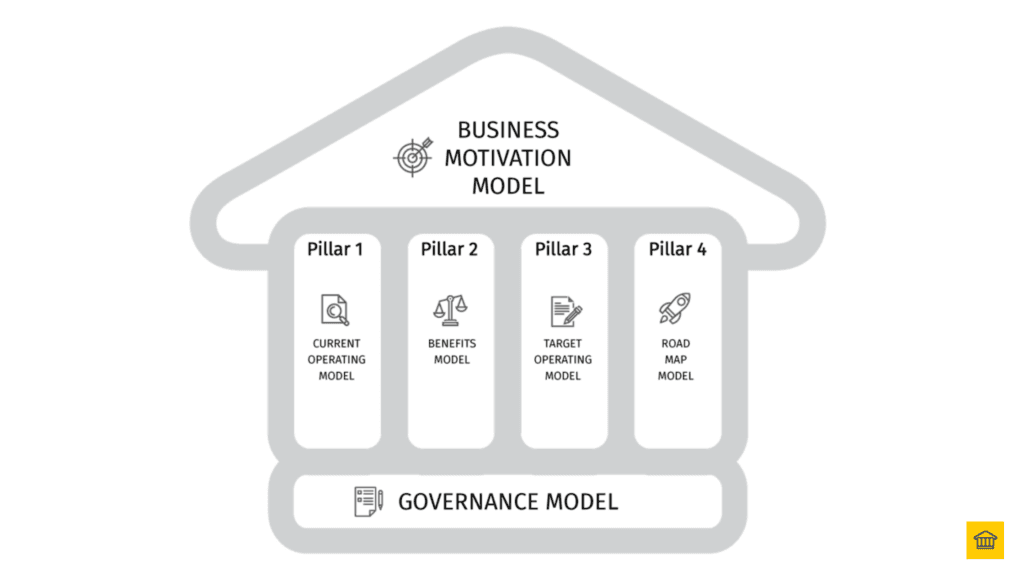
The first thing that you need to do is set the focus, direction of the organisation and the business. Many consultants make their living off Business Transformation. But implementation is unachievable and unrealistic if there’s no focus. In my book titled, The Business Transformation Playbook, this step is based on the Business Motivation Model. The model has four different aspects:
- Process
- Perspective
- Context
- Content
🔍 Click to enlarge
Step 1 - Focus (Business Motivation Model) 🎯
Let’s discuss them below:
Process
Process determines the activities necessary to identify and validate the ‘focus’ of the business. What’s the focus of the Business Architecture and Business Architect?
Perspective
Next, the perspective or point of view for this step is to provide ‘focus’ for the Business and the Business Architecture.
Context
Then we answer the “why”
-
Why is the Business doing this?
-
What do they want or expect to achieve?
-
Why is the Business Architecture and Business Architect involved?
-
What does the Business want or need them to do and achieve?
Content
The last aspect of this step is content development. The content developed in the “focus” step is used to identify and validate the vision, strategy and objectives of the business.
Step 2: Control
The next step is control. This step is based on the Governance model. The Governance Model manages the design, decisions, scope and risks of the Program and Business Architecture.
 🔍 Click to enlarge
Step 2 - Control (Governance Model) 📝
Like the first step, the model has four different aspects:
- Process
- Perspective
- Context
- Content
Process
Process addresses the activities that are important to implement the framework and the Target Operating Model (TOM).
Perspective
The Governance model adopts the “Control” perspective. It looks at the processes involved to ‘control’ the design, decisions, scope and risks for both the Business and Business Architecture.
Context
Next, this step answers the “Who” questions.
-
Who is impacted and affected by the changes to the Programme and Business Architecture?
-
What are their roles and responsibilities?
-
Who is involved in the decision making of the Programme and the Business Architecture?
-
What is their role?
-
What is their level of impact and influence?
-
What are the process(es) for managing decisions, scope and risks on the Programme?
Content
The last aspect is The Business Architecture content. This is used to define the framework and processes needed to control the design, decisions, scope and risks in developing and implementing the Target Operating Model (TOM).
👏 “Without agreeing your Governance framework and early on your transformation program, and ensuring you have the right membership, your transformation is destined to spin wheels and get no where, fast!” #BusinessTransformation #BusinessArchitecture #HOBA #GovernanceModel #Control

Step 3: Analyse
The next step is analyse. This step is based on the Current Operating Model. The Current Operating Model provides the ‘baseline’ to build and design the Target Operating Model (TOM).
 🔍 Click to enlarge
Step 3 - Analyse (Current Operating Model) 🔍
The model has four different aspects:
- Process
- Perspective
- Context
- Content
Process
This aspect identifies the areas and activities necessary to achieve the Current Operating Model. It establishes the ‘baseline’ of the organisation, which the Target Operating Model (TOM) will be built from.
Perspective
The current state and scope of the Organisation are analysed in this aspect to establish the baseline of the Organisation and Business Architecture.
Context
Context answers the ‘What?’:
- What is the current state of the Organisation today?’
- ‘What is the baseline measures and metrics of the Business the Target Operating Model (TOM) will be improving from?’
- ‘What are the elements (people, process, technology) of the Business that is affected by the Programme and Business Architecture?’
Content
In this aspect, the content developed is used to define the current state, baseline measures and metrics of the Organisation.
BUSINESS
TRANSFORMATION
101
CONFUSED WHERE TO START? GET STARTED RIGHT WITH OUR FREE GUIDE.
👏 “Defining the Current Operating Model scares the daylights out of stakeholders because they think it will never end. Its simple and painless when you know how to do it, fast!” #BusinessTransformation #BusinessArchitecture #HOBA #CurrentOperatingModel #Analyse
Step 4: Evaluate
The next step is evaluate. This step is based on the Benefits Model. The Benefits Model identifies, evaluates and prioritises the Business Benefits that the Business wants to realise. The model has four different aspects:
- Process
- Perspective
- Context
- Content
 🔍 Click to enlarge
Step 4 - Evaluate (Benefits Model) ⚖️
Process
This aspect defines the activities necessary to identify, quantify and prioritise both the Benefits the Business wants to realise from the TOM, as well as potential necessary changes too.
Perspective
Next, the benefits are evaluated and capability solution options are identified and prioritised.
Context
The Benefits Model addresses the “Why” aspect:
-
Why are we doing this?
-
What are the benefits the Organisation intends to realise?
Content
The last aspect is Benefits Model content. The content developed here is used to identify and validate the intended Business Benefits. The Business then identifies and prioritises the capabilities needed to realise those Benefits.
IS YOUR
ORGANISATION
READY TO TRANSFORM?
FIND OUT BEFORE YOU START — NOT AFTER YOU FAIL. ASSESS YOUR READINESS ACROSS 6 KEY AREAS — STRATEGY, PEOPLE, PROCESSES, TECHNOLOGY, GOVERNANCE, AND CULTURE — AND GET A FREE PERSONALISED SCORECARD REPORT WITH PRACTICAL RECOMMENDATIONS.
👏 “The Benefits Model identifies, evaluates and prioritises the Business Benefits that the Business wants to realise.” #BusinessTransformation #BusinessArchitecture #HOBA #BusinessBenefits #BenefitsRealisation
Step 5: Design
The next step is design. This step is about the design of the Target Operating Model (TOM). The design phase involves the identified and prioritised capabilities that directly drive the planned Benefits the Business intends to realise.
 🔍 Click to enlarge
Step 5 - Design (Target Operating Model (TOM)) 🖌️
The model has four different aspects:
- Process
- Perspective
- Context
- Content
Process
In terms of process, the Target Operating Model Reference Model is the 5th step in the Design Process. The design step (step 5) takes the identified and prioritised Business Changes and Enablers, from the evaluation phase (step 4) and the stakeholder concerns and needs that were identified in the Analyse phase (step 3).
The “TOM” does not explicitly mean or refer to implementation It is a model of a ‘state’ after implementation. But you just can’t implement anything, you have to test it, which again is something that many approaches don’t promote.
Everyone wants to implement a ‘big bang approach’ without any testing. We’ve included and built pilots into the whole design process to address this issue. Here’s is where you can use what you’ve learned in the previous step to develop and test the changes and implementation options are fit for purpose, before full implementation.
Context
The Target Operating Model Reference Model (TOM) answers the ‘how’ and ‘where’ questions:
-
How is the Business changed to create the Target Operating Model (TOM) that supports the Business Strategy?
-
Where are the changes made in the Business to create the TOM?
These changes are outputs from the Benefits Model – the identified Enablers (technology changes), and Business Changes (people & process changes).
Content
The Business Architecture content developed here is used to develop and validate the design of the Target Operating Model (TOM) to align the Business to the Business Strategy.
Step 6: Implement
The final step is implement. This step implements the ‘design’ of the Target Operating Model (TOM) and the ‘physical’ Business Architecture. This step uses the Road Map Model. The Target Operating Model Reference Model then provides the ‘design’ perspective to validate the ‘design’ of the Target Operating Model (TOM).
 🔍 Click to enlarge
Step 6 - Implement (Road Map Model) 🚀
The model has four different aspects:
- Process
- Perspective
- Context
- Content
Process
The Road Map Model is the 6th (and last) step of the Design Process. It brings all the work done in previous steps which involve developing the design of the TOM and implementing the physical Business Architecture.
Perspective
The Road Map Model provides the ‘implement’ perspective needed to develop the design and oversee the implementation of the physical Business Architecture and the TOM.
Context
It then addresses the ‘When?’ questions:
- When will the design of the Target Operating Model be developed, and delivered? and
- When will the physical Business Architecture be implemented?
- When will the planned Business Benefits be realised?
Content
The Business Architecture content developed here is used to deliver the roadmaps to implement the physical TOM, and the roadmaps for design, benefits and traceability. It is also used to align the implementation of the physical TOM with the design.
LOOKING
FOR THE
BEST
TRAINING?
DELIVER YOUR BUSINESS TRANSFORMATION.
👏 “The Road Map Model identifies the roadmap to deliver the TOM design, the physical changes and plan for benefits realisation. Without a practical and pragmatic roadmap for implementation, your design is worthless!” #BusinessTransformation #BusinessArchitecture #HOBA #BusinessBenefits #BenefitsRealisation
Conclusion
In conclusion, this blog post from HOBA Tech has provided a comprehensive guide to business transformation. The process, often seen as complex and daunting, has been broken down into six manageable steps: understanding the need for transformation, defining clear goals, developing a transformation strategy, communicating the transformation plan, implementing the transformation, and reviewing and adjusting the transformation process.
These steps serve as a roadmap for businesses embarking on a transformation journey, providing them with the necessary guidance to navigate the process with confidence and clarity. If you found this post informative and wish to delve deeper into the subject of business transformation and other related topics, we encourage you to explore further on HOBA Tech's website.
Should you be interested in discussing how HOBA Tech can assist your business in its transformation journey, please do not hesitate to contact us. We are eager to hear from you and assist your business in achieving its full potential.
Thank you for reading this!
Sincerely,
Heath Gascoigne
P.S. If you want to join our Business Transformation Community of 2,000+ like-minded Business Transformators, join the HOBA Community here.
P.P.S. If you want to learn more about the world’s only business-led business transformation framework, check out The Business Transformation Playbook here.

Heath Gascoigne
Hi, I'm Heath, the founder of HOBA TECH and host of The Business Transformation Podcast. I help Business Transformation Consultants, Business Designers and Business Architects transform their and their clients' business and join the 30% club that succeed.
TRANSFORM YOUR
ORGANIZATION
WITH THIS SIMPLE PROCESS
WE OFFER THE TRAINING FOR PEOPLE TO GO AND LEARN THE SKILLS NEEDED TO ACHIEVE THE SAME RESULTS AS ACHIEVED IN THIS CASE STUDY.
ENJOYING THIS POST?
GET THE NEXT ONE
Subscribe to our newsletter and get the latest insights delivered straight to your inbox.

Make HOBA Tech a Google Preferred Source.
One click and Google will start showing our articles in AI search results and AI Overviews when you search.
🚀 “Just read: "6 Steps To Business Transformation" — incredible insights on business transformation.” #BusinessTransformation