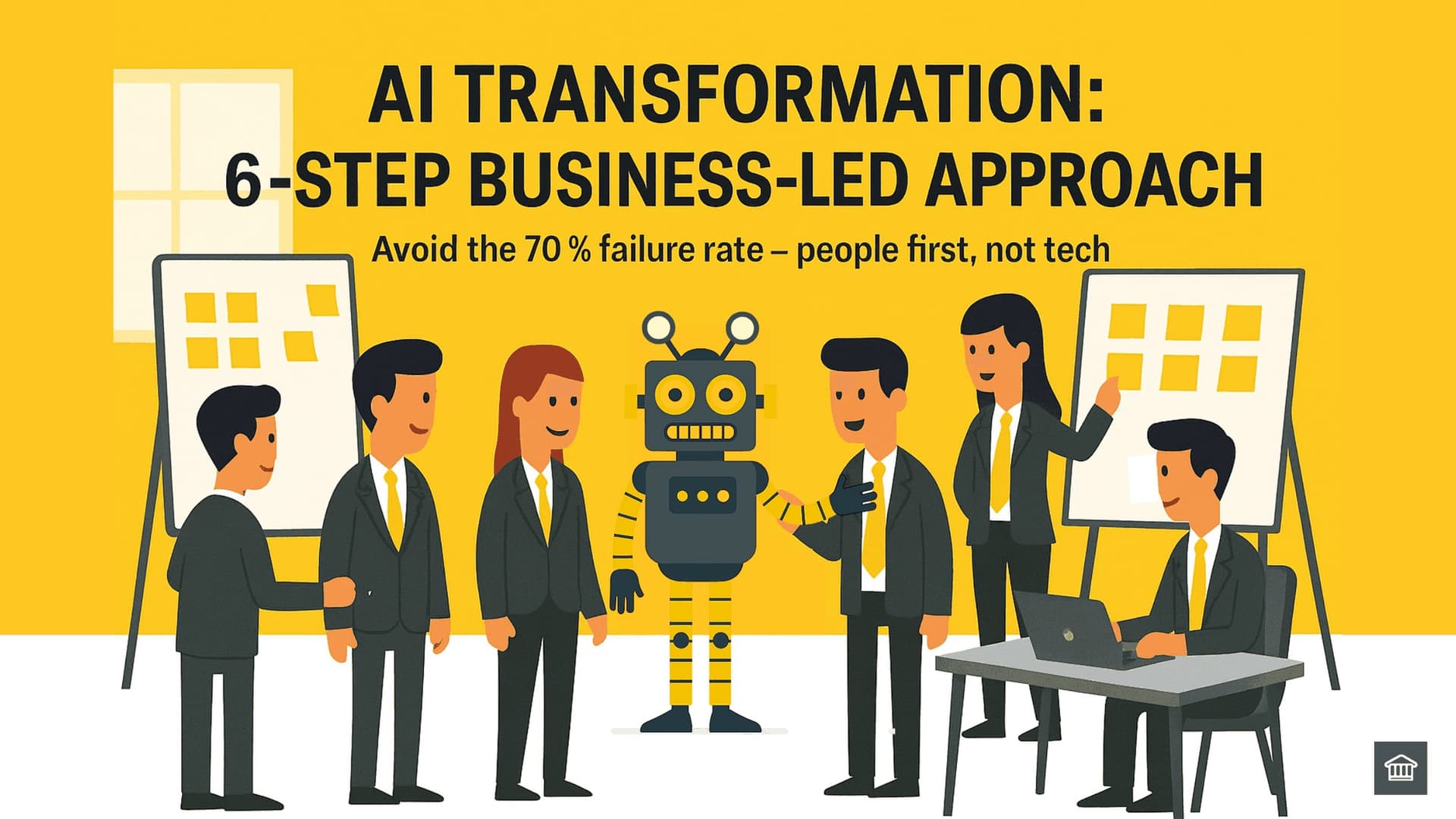
AI Transformation Guide: 6-Step HOBA Method to Avoid 70% Failure Rate
📷Click on any image to enlarge.
⚠️The Harsh Reality of AI Transformation
70% of AI transformations fail. Organizations are rushing to implement ChatGPT, machine learning, and automation tools without understanding the fundamental business problems they're trying to solve. They're putting the cart before the horse—focusing on shiny new technology instead of the people and processes that make transformation successful.
Every day, I speak with executives who tell me the same story: "We've invested millions in AI tools, but we're not seeing the promised returns." Sound familiar?
The problem isn't AI itself—it's the approach. Most organizations jump straight to the "how" (which AI tools to use) without first understanding the "why" (what business problem are we solving?). This is exactly what we address in our HOBA (Human-Oriented Business Architecture) methodology.
Use the Table of Contents below to navigate directly to the sections that matter most to you.
What is AI Transformation?
6 STEPS TO
BUSINESS
TRANSFORMATION
SUCCESS
WHAT THE TOP 30% OF ORGANISATIONS KNOW THAT YOU DON'T. GET THE FREE EBOOK NOW.
AI transformation isnot simply implementing ChatGPT or buying machine learning software. It's the strategic integration of artificial intelligence technologies into your business processes, operations, and decision-making to create sustainable competitive advantage.
AI Transformation Definition:
"AI transformation is the systematic application of artificial intelligence to solve specific business problems, improve operational efficiency, and create new value propositions—while ensuring the people, processes, and data infrastructure can support and sustain these changes."
- Heath Gascoigne, MBA
HOBA Methodology
Key Components of AI Transformation:
Strategic Alignment
AI initiatives must directly support business objectives and measurable outcomes.
People-First Approach
Change management, skills development, and cultural transformation are essential.
Process Integration
Workflows must be redesigned to leverage AI capabilities effectively.
Data Foundation
Quality data governance and infrastructure must be in place.
👏 “AI transformation isn't about the technology—it's about the business problem you're solving. Start with 'why,' not 'how.” #AITransformation #BusinessFirst #HOBA

Why 70% of AI Transformations Fail (The Technology-First Trap)
Based on our experience working with organizations like BP Oil & Gas, MHRA Government, Cigna Healthcare, and TFGM Transport, we've identified the root causes of AI transformation failure.
The Technology-First Trap
Organizations see AI demonstrations, read success stories, and immediately ask: "How can we implement this in our business?" This is putting the cart before the horse.
The correct sequence: Problem → Solution → Technology
The failing sequence: Technology → Problem → Disappointment
Top 5 Reasons AI Transformations Fail:
- Skipping the "Why" Question
Organizations jump to AI solutions without clearly defining the business problem or desired outcome.
- Ignoring People and Process
Treating AI as a technology-only solution while neglecting change management and workflow redesign.
- Poor Data Foundation
Implementing AI on top of poor data quality, inconsistent formats, or inadequate governance.
- Unrealistic Expectations
Expecting AI to solve all problems or deliver immediate ROI without proper implementation planning.
- Lack of Governance
No clear ownership, accountability, or success metrics for AI initiatives.
Key Insight from Deming's Rule
"A problem well-defined is a problem half-solved." This applies perfectly to AI transformation. Before selecting any AI tool, you must clearly define what business problem you're solving and what success looks like.
The HOBA 6-Step Approach to AI Transformation
The HOBA (House Of Business Architecture) methodology provides a structured approach that addresses the 5W1H questions essential for successful transformation.
Here's how to apply it to AI initiatives:
Step 1: Focus - Define Your 5W1H
Start with clarity. Define the fundamental questions before considering any AI solution.
The 5W1H Framework:
• Why: What business problem are we solving?
• Who: Who's involved and affected?
• What: What specific outcomes do we want?
• Where: Where will changes be implemented?
• When: When will we see results?
• How: How will we measure success?
Example: MHRA AI Project
• Why: Reduce drug approval processing time
• Who: Regulatory staff, pharmaceutical companies
• What: 40% faster document review
• Where: Document processing workflows
• When: 6-month implementation
• How: Time-to-approval metrics
Step 2: Control - Establish Governance
Scope Definition
• In-scope processes
• Out-of-scope boundaries
• Success criteria
Roles & Responsibilities
• Executive sponsor
• AI project manager
• Business stakeholders
Risk Management
• Data privacy compliance
• Ethical AI guidelines
• Change resistance plans
Step 3: Analyze - Understand Current State
Thoroughly assess your current situation across all four levers before implementing AI.
Current State Assessment:
• People: Skills, capacity, change readiness
• Process: Current workflows, bottlenecks, inefficiencies
• Technology: Existing systems, integration points
• Data: Quality, accessibility, governance
Example: London Issuance Provider
Current state analysis revealed that 60% of claims processing time was spent on manual document review, not complex decision-making. This insight shaped their AI solution to focus on document classification rather than decision automation.
Step 4: Evaluate - Assess Solutions (Not Hype)
Objectively evaluate AI solutions against business benefits, not technology features.
Evaluation Criteria
Business Impact
• ROI potential
• Strategic alignment
• Competitive advantage
Implementation Feasibility
• Technical complexity
• Resource requirements
• Timeline realism
Key Question:"Will this AI solution solve our specific business problem better than alternative approaches?"
Step 5: Design - Apply the Four Levers
Design your AI transformation across all four levers simultaneously—not just technology.
People Design
• Skills development programs
• Change management strategy
• New role definitions
• Communication plans
Process Design
• Workflow redesign
• Quality control points
• Exception handling
• Performance metrics
Technology Design
• AI tool selection
• Integration architecture
• Security requirements
• Scalability planning
Data Design
• Data quality standards
• Governance frameworks
• Privacy compliance
• Storage and access
Step 6: Implement - Execute and Realize Benefits
Execute your AI transformation with continuous monitoring and adjustment across all four levers.
Implementation Success Formula
Phase 1: Pilot (Weeks 1-4)
• Small-scale deployment
• User training
• Performance monitoring
Phase 2: Scale (Weeks 5-12)
• Gradual rollout
• Process refinement
• Stakeholder feedback
Phase 3: Optimize (Weeks 13+)
• Full deployment
• Continuous improvement
• Benefit realisation
APPLYING AI
WITH THE HOBA®
FRAMEWORK
🤖 “Stop treating AI as the complete solution. It's one of four levers: people, process, technology, and data. Master all four or join the 70% failure rate.” #AITransformation #FourLevers #TransformationFail
How AI is Transforming Industries
Let's examine how AI is being successfully implemented across different sectors using the HOBA methodology.
These examples show the importance of industry-specific approaches.
How AI Will Transform Healthcare
Current Applications:
• Diagnostic imaging analysis (radiology, pathology)
• Drug discovery and development acceleration
• Personalized treatment recommendations
• Administrative task automation
Case Study: London Issuance Provider
Problem: Claims processing taking 14 days on average
Solution: AI-powered document classification and routing
**Results:**65% reduction in processing time, 40% cost savings
Key Success Factor: Our client focused on people training and process redesign before implementing AI, ensuring clinical staff understood how to work with AI recommendations rather than be replaced by them.
How AI Will Transform Banking and Finance
Risk Management
• Fraud detection in real-time
• Credit scoring automation
• Market risk assessment
• Regulatory compliance monitoring
Customer Experience
• Chatbots for customer service
• Personalised product recommendations
• Automated loan processing
• Investment portfolio optimisation
Operations
• Document processing automation
• Anti-money laundering detection
• Trading algorithm optimization
• Back-office process automation
Industry Trend: By 2025, 80% of banking interactions will be AI-powered, but successful implementations focus on augmenting human decision-making rather than complete automation.
How AI Will Transform Education
Personalized Learning:
• Adaptive learning platforms that adjust to student pace
• AI tutoring systems for individual support
• Predictive analytics for at-risk student identification
• Automated essay grading and feedback
• Curriculum optimization based on learning outcomes
Administrative Efficiency:
• Automated scheduling and resource allocation
• Student enrolment and admissions processing
• Performance analytics and reporting
• Campus security and safety monitoring
• Library and resource management systems
Critical Success Factor: AI in education requires careful balance between personalization and privacy, with strong emphasis on teacher training and academic integration.
How AI Will Transform Project Management
Planning & Scheduling:
• Real-time progress tracking and alerts
• Quality control and testing automation
• Stakeholder communication optimisation
• Budget variance prediction and control
Execution & Monitoring:
Case Study: UK Transport Project
Our Transport Operator Client used AI to optimize their public transport infrastructure projects, reducing planning time by 45% and improving on-time delivery from 67% to 89% through predictive analytics and resource optimization.
Ready to Transform Your Organization?
Get the same methodology that helped BP Oil & Gas, MHRA Government, and Cigna Healthcare achieve successful AI transformations.
The Four Levers of Successful AI Transformation
People (Change Management and Skills)
The most critical and most neglected lever. AI changes how people work, so change management is essential.
Key Components:
• Skills Assessment: Identify current capabilities vs. future needs
• Training Programs: AI literacy, new tools, changed processes
• Change Communication: Clear messaging about AI's role
• Resistance Management: Address fears about job displacement
• Role Redefinition: How jobs change with AI augmentation
Success Tip: Position AI as augmentation, not replacement. Show people how AI makes their work more strategic and valuable.
Process (Workflow Redesign)
AI doesn't just automate existing processes—it enables entirely new ways of working.
Key Components:
• Process Mapping: Document current workflows and handoffs
• AI Integration Points: Where AI adds value vs. human judgment
• Exception Handling: What happens when AI can't decide
• Quality Controls: Validation and oversight mechanisms
• Performance Metrics: How to measure success
Success Tip: Design for human-AI collaboration, not human replacement. The best processes combine AI efficiency with human judgment.
Technology (AI Tools and Platforms)
The lever everyone focuses on first, but it should be designed after understanding people and process needs.
Key Components:
• AI Tool Selection: Match capabilities to business requirements
• Integration Architecture: How AI connects to existing systems
• Security Requirements: Data protection and access controls
• Scalability Planning: How the solution grows with demand
• Vendor Management: Build vs. buy vs. partner decisions
Success Tip: Start with proven, enterprise-grade solutions. Avoid the temptation to build custom AI unless it's truly your core differentiator.
Data (Quality and Governance)
AI is only as good as your data. Poor data quality is the #1 cause of AI project failure.
Key Components:
• Data Quality Assessment: Accuracy, completeness, consistency
• Governance Framework: Ownership, access, privacy controls
• Data Preparation: Cleaning, formatting, validation processes
• Privacy Compliance: GDPR, CCPA, industry regulations
• Storage and Access: Where data lives and who can use it
Success Tip: Invest in data quality before AI implementation. "Garbage in, garbage out" is especially true for AI systems.
The Four Levers Integration Matrix
Successful AI transformation requires all four levers working together. Here's how they interconnect:
People ↔ Process:
New workflows require new skills; skilled people enable better processes
Process ↔ Technology:
AI capabilities shape process design; processes define technology requirements
Technology ↔ Data:
AI tools need quality data; data strategy influences technology selection
Data ↔ People:
Data governance requires human oversight; people generate and validate data
Common Mistakes to Avoid in AI Transformation
Learn from the failures of others. These are the most common mistakes we see organizations make, based on our analysis of failed AI projects.
Mistake #1: Technology-First Approach
What it looks like:"We need to implement ChatGPT/machine learning/automation in our business. How do we do it?"
Why it fails:
• No clear business problem definition
• Solution looking for a problem
• No success criteria or ROI measurement
How to avoid it:
• Start with the 5W1H questions
• Define business problem before solution
• Establish clear success metrics
Mistake #2: Ignoring the People Lever
What it looks like:"We'll just install the AI system and people will figure it out."
Why it fails:
• User resistance and non-adoption
• Skills gaps and training needs ignored
• Fear and uncertainty about job security
How to avoid it:
• Include change management from day one
• Communicate AI as augmentation, not replacement
• Invest in skills development and training
Mistake #3: Poor Data Preparation
What it looks like:"Our data isn't perfect, but the AI will clean it up as it learns."
Why it fails:
• Garbage in, garbage out principle
• AI amplifies existing data problems
• Inconsistent or biased results
How to avoid it:
• Conduct thorough data quality assessment
• Establish data governance framework
• Clean and validate data before AI training
Mistake #4: Unrealistic Expectations
What it looks like:"AI will solve all our problems and deliver ROI within 3 months."
Why it fails:
• Overpromising and underdelivering
• Stakeholder disappointment and lost support
• Premature project cancellation
How to avoid it:
• Set realistic timelines (6-18 months)
• Start with pilot projects for quick wins
• Communicate limitations and learning curve
Mistake #5: Lack of Governance and Oversight
What it looks like:"Let's let different departments implement their own AI solutions independently."
Why it fails:
• Fragmented and incompatible solutions
• Security and compliance risks
• Duplicated efforts and wasted resources
How to avoid it:
• Establish central AI governance committee
• Create standards and approval processes
• Coordinate across departments and projects
IS YOUR
ORGANISATION
READY TO TRANSFORM?
FIND OUT BEFORE YOU START — NOT AFTER YOU FAIL. ASSESS YOUR READINESS ACROSS 6 KEY AREAS — STRATEGY, PEOPLE, PROCESSES, TECHNOLOGY, GOVERNANCE, AND CULTURE — AND GET A FREE PERSONALISED SCORECARD REPORT WITH PRACTICAL RECOMMENDATIONS.
🤖 “70% of AI projects fail because they ask 'How can we use AI?' instead of 'What business problem are we solving?' Wrong question = wrong solution.” #AIFail #BusinessFirst #ProblemSolving
Tips for Efficient AI Transformation
Based on successful implementations at organizations like BP Oil & Gas, MHRA Government, and Beasley Insurance, here are proven strategies to accelerate your AI transformation while avoiding common pitfalls.
Strategic Efficiency Tips
- Start with "Why," Not "How"
Define the business problem clearly before exploring AI solutions. A well-defined problem is half solved.
- Use the 5W1H Framework
Systematically address Why, Who, What, Where, When, and How to avoid missing critical requirements.
- Choose Quick Wins First
Select initial AI projects with high impact and low complexity to build momentum and stakeholder confidence.
- Establish Executive Sponsorship
Secure visible leadership support to overcome resistance and ensure resource allocation.
Tactical Efficiency Tips
- Apply All Four Levers Simultaneously
Don't sequence people, process, technology, and data—address them in parallel for faster implementation.
- Use Proven Platforms
Leverage established AI platforms (Microsoft Copilot, Google Workspace AI) rather than building from scratch.
- Implement Continuous Learning
Build feedback loops and measurement systems to continuously improve AI performance and user adoption.
- Create Cross-Functional Teams
Include business users, IT, data experts, and change managers on the same project team from day one.
AI Transformation Acceleration Framework
Follow this proven sequence to reduce implementation time from 18 months to 6-9 months:
Weeks 1-2: Foundation
• Complete 5W1H analysis
• Assess current state (4 levers)
• Define success criteria
• Establish governance
Weeks 3-8: Design
• Solution evaluation
• Process redesign
• Technology selection
• Change management planning
Weeks 9-24: Implementation
• Pilot deployment (Weeks 9-12)
• Scaled rollout (Weeks 13-20)
• Optimisation (Weeks 21-24)
• Benefit realisation
Time-Saving Tools and Templates
Assessment Tools:
• AI Readiness Assessment (4 levers evaluation)
• Data Quality Audit Template
• Change Readiness Survey
• ROI Calculation Framework
Implementation Tools:
• HOBA Business Transformation Canvas Template
• Stakeholder Communication Matrix
• Risk Assessment and Mitigation Guide
• Success Metrics Dashboard Template
Get Started: Download our free AI Transformation Readiness Assessment to identify your organisation's strengths and gaps across all four levers.
Troubleshooting and Frequently Asked Questions
Based on the most common questions from Answer Socrates and our client experience, here are the answers to help you navigate your AI transformation journey.
What is AI transformation exactly?
AI transformation is the strategic integration of artificial intelligence into your business processes, operations, and decision-making to solve specific problems and create competitive advantage. It's not just implementing AI tools—it's changing how your organization works to leverage AI capabilities effectively.
Key point: AI transformation focuses on business outcomes, not technology features.
How long does AI transformation take?
Typical AI transformation takes 6-18 months, depending on scope and organizational complexity. Quick wins can be achieved in 2-3 months, while enterprise-wide transformation requires 12-18 months.
Timeline breakdown: Foundation (2 months) → Pilot (2-3 months) → Scale (6-12 months) → Optimize (ongoing)
Will AI transform jobs and eliminate positions?
AI will transform jobs more than eliminate them. Studies show AI creates more jobs than it displaces, but requires different skills. The key is positioning AI as augmentation that makes people more productive and strategic.
Success strategy: Focus on reskilling and showing people how AI makes their work more valuable, not obsolete.
How can AI transform my specific industry?
AI applications vary by industry, but the HOBA approach works universally. The key is identifying your industry's specific pain points and evaluating how AI addresses them across the four levers (people, process, technology, data).
Common AI Applications:
- Process automation
- Predictive analytics
- Decision support
Industry-Specific Uses:
- Healthcare: Diagnostic assistance
- Finance: Risk assessment
- Manufacturing: Quality control
What are the main causes of AI transformation failure?
The top causes are: 1) Jumping to technology without defining business problems, 2) Ignoring people and change management, 3) Poor data quality, 4) Unrealistic expectations, and 5) Lack of governance.
Prevention: Use the HOBA 6-step methodology to address all causes systematically.
How do I know if my organization is ready for AI transformation?
Assess readiness across four dimensions: 1) Clear business problems to solve, 2) Leadership commitment and change readiness, 3) Data quality and accessibility, 4) Technical infrastructure and skills.
Quick readiness check: Can you clearly articulate what business problem AI will solve and how success will be measured? If yes, you're ready to start.
Should we build AI capabilities in-house or use external solutions?
For most organizations, start with proven external AI platforms (Microsoft Copilot, Google AI, AWS AI) unless AI is your core differentiator. Building in-house requires significant data science expertise and resources.
Decision framework: Buy for general capabilities, build for unique competitive advantages.
How do we measure ROI from AI transformation?
Measure both quantitative metrics (cost reduction, time savings, revenue increase) and qualitative benefits (decision quality, employee satisfaction, customer experience). Establish baselines before implementation.
Quantitative Metrics:
• Process time reduction (%)
• Cost savings ($)
• Error rate reduction (%)
Qualitative Benefits:
• Decision quality improvement
• Employee productivity gains
• Customer satisfaction scores
What skills do we need for successful AI transformation?
You need a combination of business, technical, and change management skills. Key roles include: AI project manager, business analyst, data analyst, change manager, and executive sponsor. External expertise can fill gaps initially.
Most important skill: Business problem definition and solution evaluation—technical AI knowledge can be acquired or outsourced.
How do we handle employee resistance to AI?
Address resistance through clear communication, skills training, and positioning AI as augmentation rather than replacement. Involve employees in solution design and show how AI makes their work more strategic and valuable.
Key message: "AI handles routine tasks so you can focus on strategic, creative, and relationship-building work that only humans can do."
Stop Being Part of the 70% That Fail
Join the organizations that succeed with AI transformation using the proven HOBA methodology
Join HOBA Academy - $1,498 (Was $1,997) Free AI Readiness Assessment
✅ 25% Off with code FOUNDER25 ✅ 6-Week Program ✅ Real Case Studies
✅ Money-Back Guarantee
Conclusion: Your AI Transformation Journey Starts Now
AI transformation is not about the technology—it's about solving business problems systematically using a people-first approach. The organizations that succeed follow structured methodologies like HOBA that address all four levers: people, process, technology, and data.
Key Takeaways:
• 70% of AI transformations fail because they focus on technology first, people last
• Use the HOBA 6-step methodology: Focus, Control, Analyze, Evaluate, Design, Implement
• Apply all four levers simultaneously: people, process, technology, and data
• Start with "Why" not "How"—define business problems before selecting AI solutions
• Success requires executive sponsorship, change management, and realistic expectations
Whether you're transforming healthcare operations like Cigna, optimizing government processes like MHRA, or improving transportation systems like TFGM, the principles remain the same: understand your problems, design comprehensive solutions, and execute systematically.
Don't let your organization become another AI transformation failure statistic. Start with the fundamentals, follow a proven methodology, and remember that successful AI transformation is ultimately about helping people work better, not replacing them.
Ready to begin your AI transformation journey?
LOOKING
FOR THE
BEST
TRAINING?
DELIVER YOUR BUSINESS TRANSFORMATION.
👏 “AI isn’t the strategy. It’s the final step of a structured one. Businesses that win with AI eliminate waste first and think human-first—not tech-first.” #BusinessLedTransformation #AIforBusiness #4plus1AI #HOBATech #FutureOfWork #AgileTransformation
Your Next Steps: Tools and Resources
You now understand the 6 Steps to AI Transformation. Here's how to put it into action:
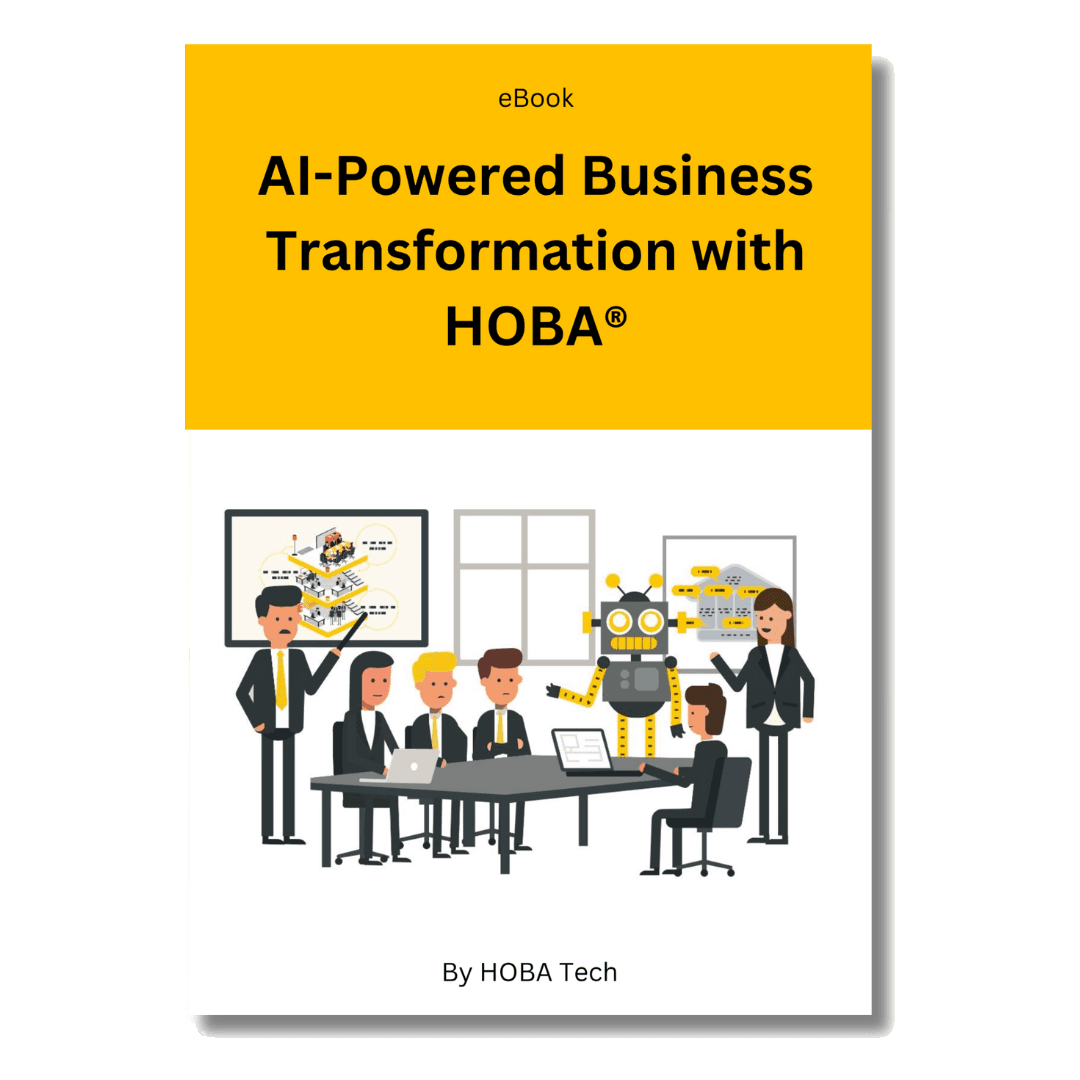
🎁 FREE Resource 1: AI-Powered Transformation Using HOBA eBook
Get our comprehensive guide to applying the HOBA methodology to AI transformation projects. Includes templates, case studies, and implementation checklists.
🎁 FREE Resource 2: AI Readiness Scorecard
Assess where your organization stands across the 6-Steps. Identify gaps. Prioritize your next steps.
Take the AI Readiness Assessment →
📅 Upcoming Webinar: Implementing the 6-Step Process (Early November)
Join Heath Gascoigne for a live deep-dive into the process to AI Transformation. Bring your questions. Get personalised guidance on applying this framework to your specific challenges.
Register for the Free Webinar →
🚀 HOBA Pro AI Beta: Coming Soon
Experience business transformation powered by structured AI. HOBA Pro combines our proven methodology with AI assistance to guide you through the entire transformation process.
Get Early Access to HOBA Pro AI Beta →
👏 “You wouldn’t build a house without clearing the land first. Why would you build AI on broken processes? The HOBA 6-Step Process gives you the foundation to scale smart.” #AIReadiness #TransformationLeadership #HOBAMethod #OperationalExcellence #ProcessBeforeTech
💬 Call to Action:
👐 Become a HOBA Founding Partner - Join the exclusive ANZ launch (10 seats only, apply by 30 Nov or until fully allocated
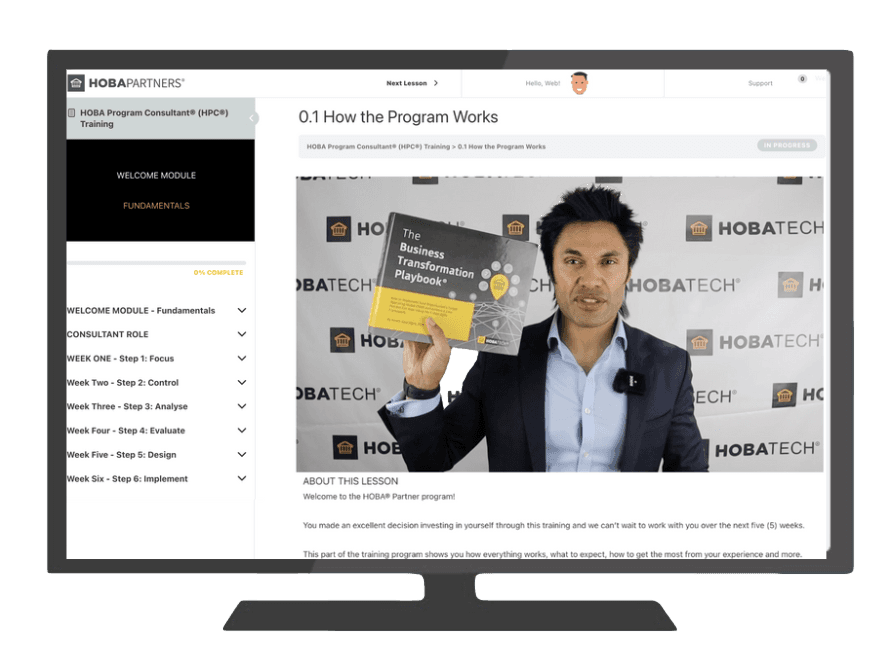
📚 Partner Toolkit – Full access to HOBA frameworks, templates, and the award-winning Playbook
🚀 Early Access to HOBA Pro AI – Be the first to use the AI-powered transformation platform
📞 Or schedule a call with Heath or our team to review your suitability for the Partner Programme – Apply here
🚀 “The real question with AI isn’t what tool to use, it’s what business problem you’re solving. Strategy comes first, technology follows” #HOBAtech #AIstrategy #BusinessTransformation
About HOBA Tech
If this resonated with you, discover how to make Business Transformation a reality—with less stress, fewer resources, and faster results. Explore our award-winning agile Business Transformation Framework, trusted by organizations worldwide, from the UK Government and FTSE-100 companies to innovative start-ups. Ready to begin your transformation journey? Start here.
Curious why_The Business Transformation Playbook_ is hailed as the “Business Transformation Bible”? See what readers are saying in the Amazon reviews.
We’d love to hear your thoughts! Let us know in the comments what stood out to you or what topics you’d like us to cover next. If you found this valuable, share it with others who could benefit!
Thank you for reading, and here’s to your transformation success!
Sincerely,

Heath Gascoigne
P.S. If you want to join our Business Transformation Community of 2,000+ like-minded Business Transformators, join the HOBA Community here.
P.P.S. If you want to learn more about business transformation, check out The Business Transformation Playbook.

Heath Gascoigne
Hi, I'm Heath, the founder of HOBA TECH and host of The Business Transformation Podcast. I help Business Transformation Consultants, Business Designers and Business Architects transform their and their clients' business and join the 30% club that succeed.
TRANSFORM YOUR
ORGANIZATION
WITH THIS SIMPLE PROCESS
WE OFFER THE TRAINING FOR PEOPLE TO GO AND LEARN THE SKILLS NEEDED TO ACHIEVE THE SAME RESULTS AS ACHIEVED IN THIS CASE STUDY.

ENJOYING THIS POST?
GET THE NEXT ONE
Subscribe to our newsletter and get the latest insights delivered straight to your inbox.

Make HOBA Tech a Google Preferred Source.
One click and Google will start showing our articles in AI search results and AI Overviews when you search.
🚀 “Just read: "AI Transformation Guide: 6-Step HOBA Method to Avoid 70% Failure Rate" — incredible insights on business transformation.” #BusinessTransformation